
Foreign confidence in Indonesian assets, passive fund flows and the stock market's liquidity premium will hinge on MSCI's imminent verdict on the country's emerging-market status, asset manager Ashmore said, even as a fragile Middle East ceasefire and a surprisingly hawkish US Federal Reserve reshape the backdrop for emerging markets.
In its weekly commentary, Ashmore Asset Management Indonesia said a full downgrade to frontier status is not its base case, but the formal decision will set the tone for foreign positioning. MSCI recently cut Indonesia's information-flow criterion to negative, citing continuing concerns over the transparency of share-ownership structures and signs of unusual trading, while leaving its other components unchanged and still rating the country better than several emerging-market peers. The classification decision is due within days.
There are tentative signs the mood is turning. The benchmark Jakarta Composite Index ended little changed on Friday, but well above the previous week's level near 6,008, and foreign investors bought a net 129 million US dollars of Indonesian equities over the week, an early reversal after months of selling.
A shifting global backdrop
The improvement comes as a brutal energy shock eases. Global sentiment has been supported by hopes for peace between the United States and Iran, whose conflict shut the Strait of Hormuz earlier in 2026 and triggered what the International Energy Agency called the largest supply disruption in the history of the oil market, pushing Brent crude past 120 dollars a barrel at its peak. The two sides have reached a framework to extend a ceasefire and begin nuclear talks, and tankers have started returning through the strait, though Ashmore cautioned that normalization is incomplete, with some routes still limited.
Brent fell about 9 percent over the week and is down roughly 20 percent from its 2026 highs, relieving some of the inflation pressure the war had generated. The key shift, Ashmore noted, is that investors have moved from fearing further escalation to worrying about whether the deal can actually be implemented. Oil prices turned volatile late in the week after peace talks in Switzerland were called off, underscoring how fragile the truce remains.
Working the other way is the Fed. In a twist that unsettled markets just as geopolitical risk was receding, the central bank under new chair Kevin Warsh held its benchmark rate but signaled a hawkish shift at his first meeting. The updated dot plot showed nine of 19 officials now expecting at least one rate increase in 2026, up from none previously, reflecting energy-driven price pressure and inflation that has stayed above the Fed's 2 percent goal. Investors have abandoned earlier bets on rate cuts and now brace for tighter policy for longer, keeping the dollar and US yields firm, a familiar headwind for emerging-market assets including Indonesia's.
A case for selectivity
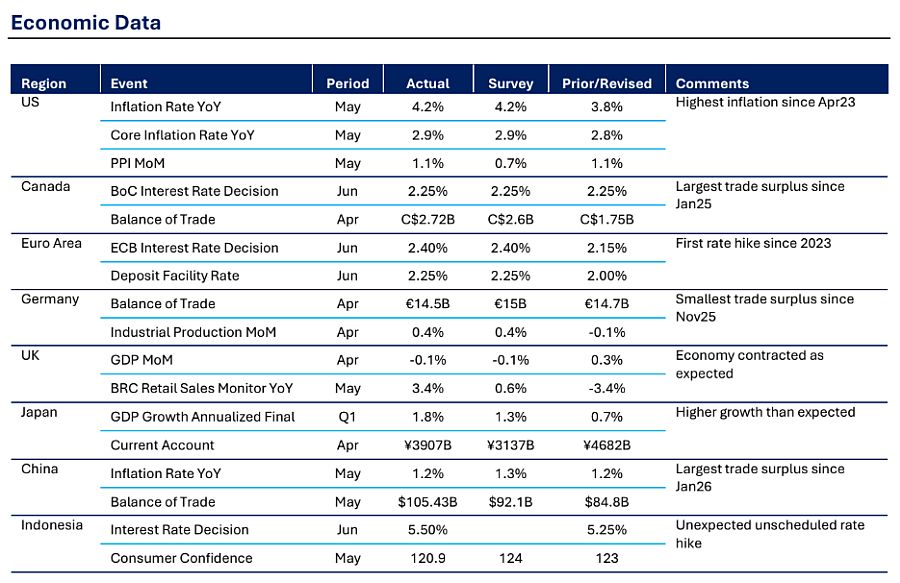
At home, Ashmore said Bank Indonesia's 25 basis-point increase to 5.75 percent on June 18 was in line with expectations and reinforced the central bank's focus on rupiah stability and investor confidence. The firm argued the current environment calls for caution but, more importantly, selectivity. Lower oil prices and a steadier rupiah support sentiment, it said, but concerns over domestic policy are keeping investors focused on liquid stocks with strong fundamentals.
Ashmore flagged three things the market will watch from here: whether the US-Iran ceasefire leads to genuine normalization of Hormuz shipping and keeps oil prices low, whether Indonesia's policy mix can stabilize the rupiah without choking off growth, and whether MSCI and other index providers grow more confident in the country's transparency reforms. If all three improve, the firm said, Indonesian assets could see a recovery in foreign confidence, though it is staying selective on names with strong fundamentals and keeping cross-asset diversification amid the volatility.
The MSCI ruling is the nearest-term catalyst. For a market down sharply this year and only now seeing a flicker of foreign buying, the verdict will help decide whether that tentative return becomes a genuine one, or fades back into caution.


0 Komentar